Anathera is building a new category of AI hardware for agentic inference: fast tokens for every user, designed for lower cost and lower energy per token.
More generated tokens per second, per user, compared with a leading GPU rack.
Designed for faster decode in agentic inference with large frontier models, targeting lower cost and energy per token.
Modeled for a 1-trillion-parameter model with a 128k-token context. Pre-silicon target; not measured performance.
THE PROBLEM WE’RE SOLVINGLONG SESSIONS. LESS WAITING.
Agents wait. The work slows down.
Fast tokens for every user. Lower cost and lower energy per token.
Long-running AI agents repeatedly reason, use tools and generate the next response. Each dependent step waits for the last. Slow token generation adds up across the whole task.
As model size and session length grow, moving model weights and session data becomes harder. The challenge is to deliver fast decode for each user while controlling memory, communication, power and cost.
We’re building Gabrielle: hardware designed for long agentic inference, working alongside GPU infrastructure. GPUs handle prefill; Gabrielle targets fast, efficient decode with the model and its session cache held close in high-bandwidth memory.
LONG SESSIONS. SERIAL STEPS.Every token moves the agent forward.
THE BIGGER PICTURESIX SIGNALS OF THE AGENTIC ERA
The next workload is already taking shape.
From training scale to sustained inference. Explore the forces behind a different kind of AI infrastructure.
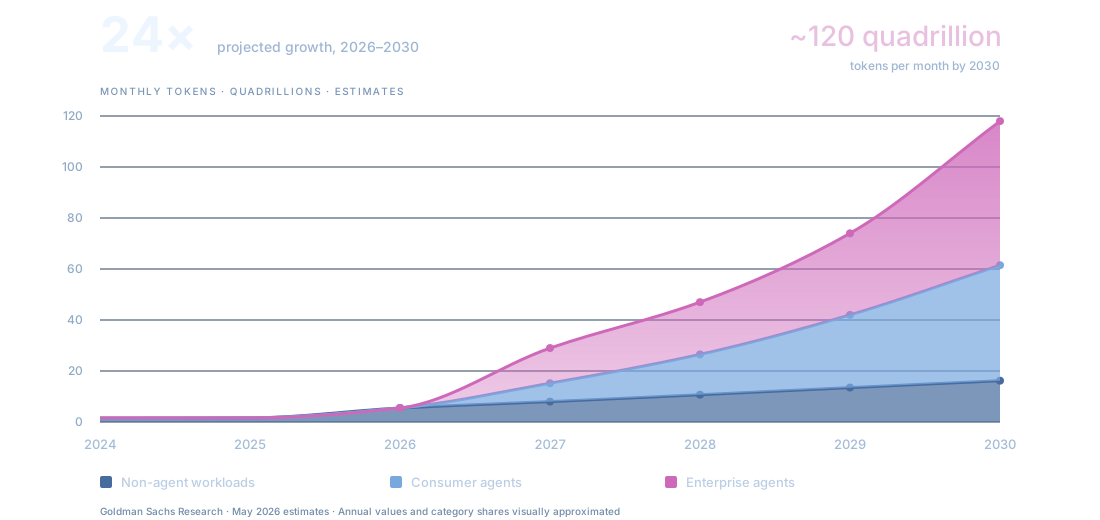
AI token consumption is estimated to grow 24× by 2030 as agentic workflows scale. Reported agent token use spans roughly 4–30× that of chatbots per interaction or task, depending on the system.
Goldman Sachs Research ↗ · 24× forecast, 2026–2030.Anthropic ↗ · About 4× for agents and 15× for multi-agent systems versus chats in its data.Gartner ↗ · 5–30× per task versus a standard GenAI chatbot.
The 4–30× range combines separate reports with different workloads and baselines; it is not a single benchmark or a universal multiplier.
More work. More inference.
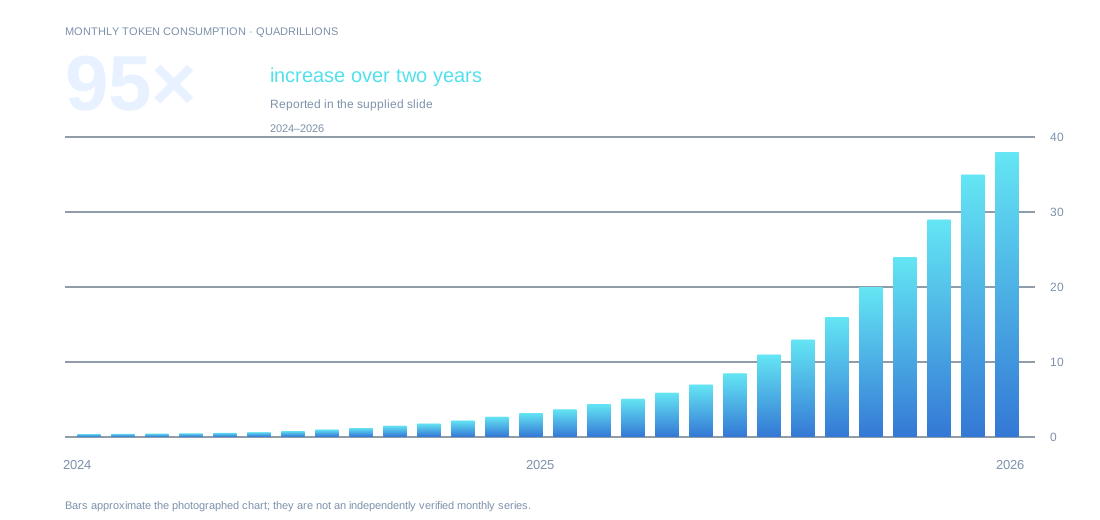
Demand for AI continues to accelerate
Reported trend · recreated reference
↔ Swipe to explore the chart
The supplied slide reports 95× growth over two years and credits Exponential View, State of the AI Economy, September 30, 2026. The monthly bars are approximate; the underlying series was not independently verified.
Source attribution from supplied slide: Exponential View
Source & reconstruction notes +
The chart reproduces the direction, headline and approximate scale of the supplied image. It should not be read as a verified monthly time series or a forecast.
The scale behind the intelligence.
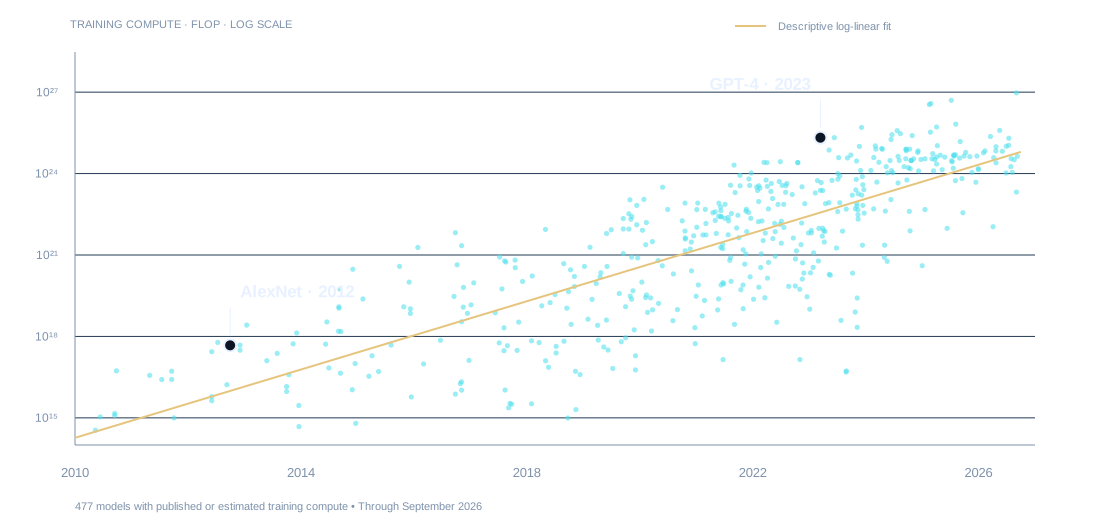
Training compute of notable AI models
Real data · Epoch AI
↔ Swipe to explore the chart
477 published or estimated training-compute values, 2010–September 2026. The gold line is a descriptive fit to the plotted values, not a forecast.
Retrieved October 24, 2026. Filtered to models with a known training-compute value between 10¹⁴ and 10²⁸ FLOP. Estimates can be uncertain. Replotted under CC BY 4.0.
AI moves into real workflows.
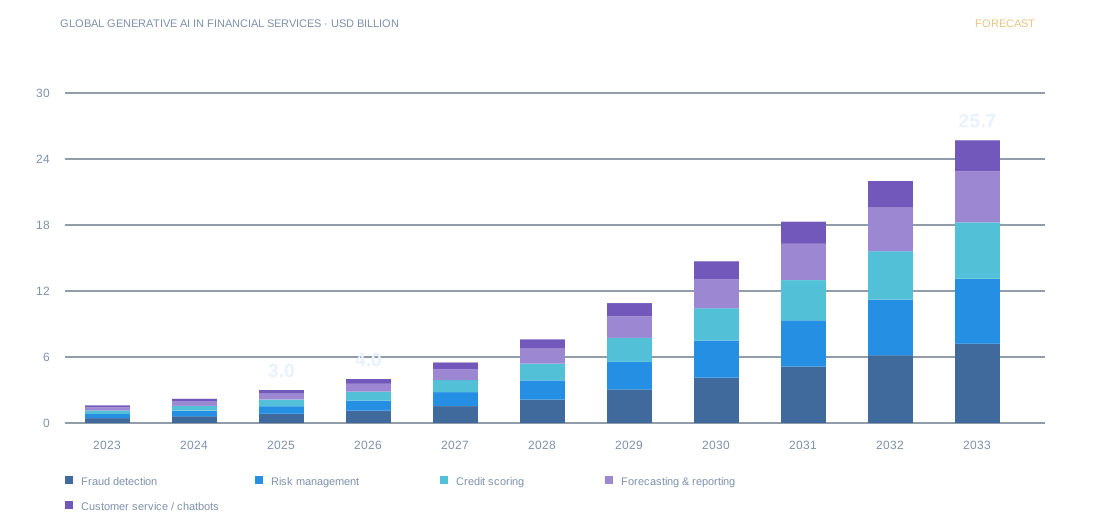
Generative AI in financial services
Forecast · recreated reference
↔ Swipe to explore the chart
The source labels $3.0B in 2025, $4.0B in 2026 and $25.7B in 2033. Other annual bars and application shares are approximate visual reconstructions, not published segment data.
The forecast describes the broader generative AI financial-services market, not Anathera revenue or an agentic-only market. The unsupported “two-thirds of budget” video overlay has not been included.
The demand reaches every layer.
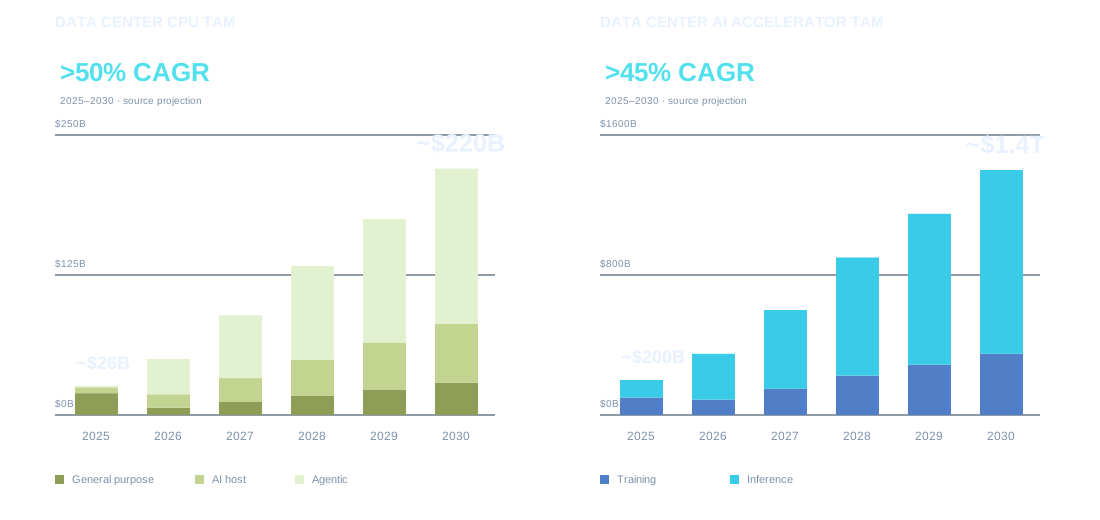
Demand across CPUs and AI accelerators
Projection · recreated reference
↔ Swipe to explore the chart
AMD internal projections, as attributed in the supplied slide. 2025 and 2030 totals and CAGR labels are transcribed; intermediate bars and category splits are approximate.
The photographed slide is the source for the specific $220B and $1.4T endpoints. The linked AMD release provides broader industry context, not verification of every plotted value. These are projections, not realized sales or Anathera’s addressable market.
Training builds capability. Inference puts it to work.
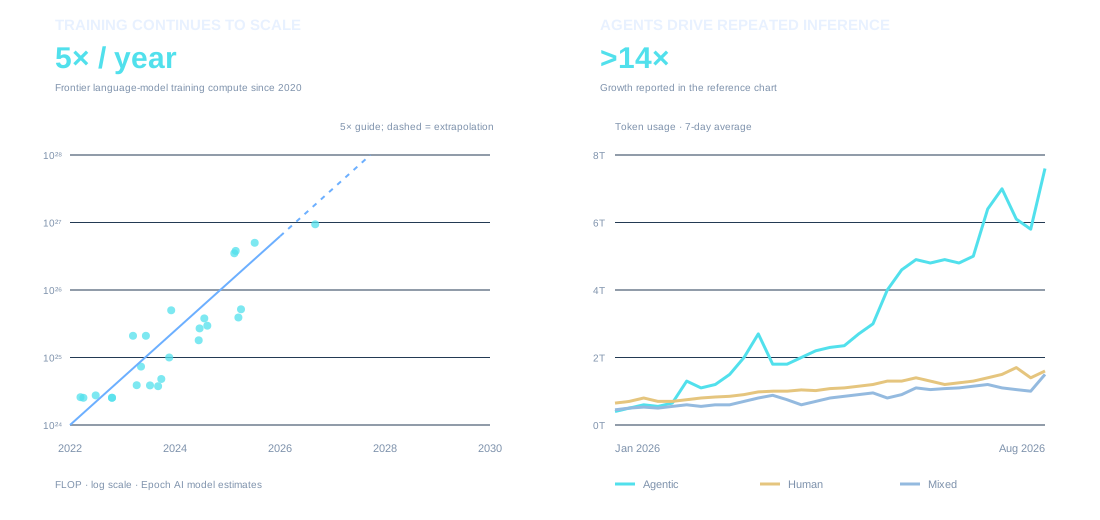
Training scales. Agentic workloads grow.
Real training data + reconstructed usage
↔ Swipe to explore the chart
Left: Epoch AI frontier-model estimates and a 5× annual guide; the dashed continuation is illustrative. Right: approximate reconstruction of the supplied OpenRouter usage chart, including its >14× headline. Platform traffic is not the entire AI market.
The inference curve is visually reconstructed from the supplied reference, not downloaded OpenRouter observations. Token counts may include reused or cached inputs and do not directly measure spending, output tokens, or decode compute. See OpenRouter’s rankings for platform context.
From answering questions to carrying out work.
A 24× expansion in token demand.
Forecast · May 2026
↔ Swipe to explore the chart
Goldman Sachs Research projects token consumption rising 24-fold from 2026 to 2030, reaching about 120 quadrillion tokens per month as consumer and enterprise agents expand. This is a forecast, not measured demand.
Recreated from the supplied chart, labeled “Estimates as of May 2026.” The linked article confirms the 24× headline and approximately 120-quadrillion endpoint. Annual values and category shares are visually approximated. The stacked boundaries are cumulative totals, not separate series to add together. Token volume does not directly measure spending or compute.